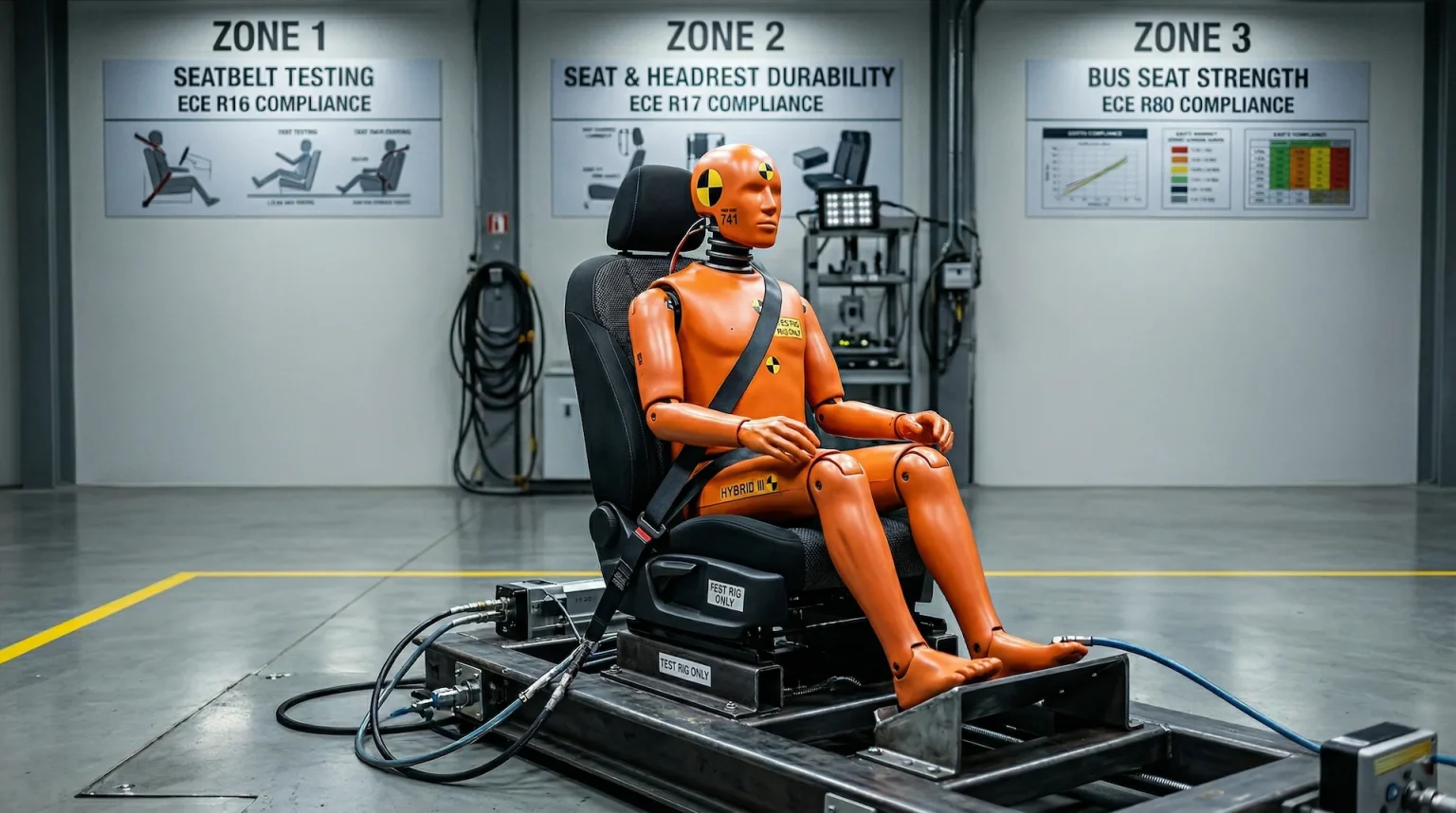
What Are ECE Regulations?
ECE regulations are among the most important standards defining vehicle safety. In particular, R16, R17, and R80 form the foundation of in-vehicle safety systems.
ECE regulations require vehicles and their components to meet specific safety standards.
- They are mandatory for market entry
- They have international validity
- A product cannot be considered compliant without testing
In other words, a product may be good, but it cannot be sold without proper testing.
What Is ECE R16? Safety Belt Systems
ECE R16 covers safety belts and restraint systems used in vehicles.
This Regulation Tests
- The strength and durability of safety belts
- The performance of buckle mechanisms
- Behavior during a crash
Reference Conditions
ECE R16 is also important because it defines reference conditions used in different restraint-related safety tests.
For example, in certain dynamic test applications, a 75 kg test dummy defined in ECE R16 can be secured to the system to evaluate restraint behavior under impact or acceleration loads.
What Is ECE R17? Seats, Head Restraints, and Strength Tests
ECE R17 focuses on the safety of vehicle seats and head restraints.
Rear Impact
Seat performance during rear impact is evaluated as part of occupant safety.
Neck Protection
Head restraints are tested for the neck protection they provide during impact scenarios.
Seat Anchorage
The strength of seat anchorage systems is assessed to verify structural performance.
What does this mean in real life? In a crash, a seat is not just a place to sit; it is a life-saving safety component.
What Is ECE R80? Bus Seats and Passenger Safety
ECE R80 is specifically designed for buses, minibuses, and public transportation vehicles.
Application Area
- Buses
- Minibuses
- Public transportation vehicles
This Standard Evaluates
- Seat strength during collisions
- Passenger safety
- Interaction between seats
Why Are These Regulations So Important?
Because the issue is not just compliance. It also directly impacts market access, legal liability, brand trust, and product quality.
Market Access
Compliance is one of the most important requirements for bringing an automotive product to market.
Legal Liability
Proper testing helps reduce regulatory and legal risks throughout the product lifecycle.
Brand Trust
Tested and validated products strengthen trust in the brand and its engineering process.
A poorly tested product cannot enter the market, carries recall risks, and can lead to significant costs.
How Does the Testing Process Work?
The testing process typically follows a structured path from engineering to certification.
- Design and engineering
- Pre-tests and simulations
- Physical testing, including sled tests where required
- Regulatory validation
- Reporting and certification
The most critical point: Proper planning of the testing process.
Poorly planned testing can create time loss, additional costs, and re-testing requirements.
Why Is the Right Testing Partner Critical?
Knowing the regulations alone is not enough. What truly matters is managing the process efficiently and accurately.
Faster Results
A strong testing infrastructure helps shorten validation processes.
Fewer Repetitions
Accurate preparation reduces unnecessary repeat tests.
Clearer Reporting
Clear reporting supports regulatory validation and certification processes.
ECE R16, R17, and R80
ECE R16, R17, and R80 are the cornerstones of automotive safety. Compliance with these regulations is not just a requirement; it is also a competitive advantage.
- Reduce risks
- Accelerate development timeline
- Develop safer products
Frequently Asked Questions
What is ECE R16?
ECE R16 covers safety belts and restraint systems used in vehicles. It evaluates belt strength, buckle performance, and restraint behavior during crash-related conditions.
What is ECE R17?
ECE R17 focuses on vehicle seats, head restraints, rear impact performance, neck protection, and seat anchorage strength.
What is ECE R80?
ECE R80 applies to buses, minibuses, and public transportation vehicles. It evaluates seat strength, passenger safety, and interaction between seats.
Why is testing important for compliance?
Without proper testing, a product cannot be considered compliant. Testing supports market access, product quality, legal safety, and brand trust.
Plan Your Safety Testing Process Correctly
With the right testing processes, you can reduce risks, accelerate your development timeline, and bring safer products to market with greater confidence.